Science Projects – Learn About Ants
Observing an Ant is The Best Way to Learn About Ants
Do you know where to find ants? The sidewalk or driveway are good places to look. You might even find some inside your house! It’s hard to see ants in the grass since they are so tiny, but you can usually find them living under rocks or logs. Just be careful, because there may be other insects living there, too.
Now that you know where to look, go outside and find some ants! When you find one, use a magnifying glass to get a closer look. Follow it around and watch what it does for as long as you can. If you have a bug jar, you can catch one or two ants to get an even better look at them. Let’s learn about ants.
Do you know the parts of an ant? Look at the ant you found and answer these questions:
1. How many legs does it have?
2. How many segments or sections does its body have?
3. Do you know what the sections are called?
4. How many feelers does it have? Feelers are called antennae (find out about this word in the Science Words section below!).
5. Can you tell what the ant uses its feelers for?
What Temperature Do Ants Like Best?
Do you get tired of running around and playing outside more quickly when it is very hot out? What if it is very cold out? Do you think temperature affects how fast ants move, too? If you have an ant farm, do this experiment and find out! (Or, if you don’t have an ant farm, you can put a few ants in a jar with small holes in the lid instead.)
1. Look at the ants in your ant farm and notice how fast or slow they are moving.
2. Put your ant farm in the refrigerator. Make sure it does not tip over!
3. After 10 minutes, take the ant farm out and look at the ants again. How fast are they moving now? Are they moving faster or slower than they were before you put them in the fridge?
Why do you think that happened to the ants? Ants are cold-blooded just like all other insects and some other animals, like reptiles. Humans, as well as other animals, are warm-blooded. What’s the difference? Well, cold-blooded animals are not able to control the temperature of their own bodies, but the bodies of warm-blooded animals try to stay at a certain temperature even if they are in a place that is very cold or very hot.
This means that when an ant is in someplace cold, its body gets cold very quickly. It is harder for ants to move around when they are cold! They are more active and can move much faster when they are warm. Not all types of ants like the same temperature though. For example, ants that live in the deserts of Africa like hotter temperatures better than ants that live close to the mountains in Colorado!
Ant Food – Are Ants Picky Eaters?
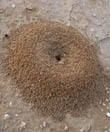
- Find an anthill or a place where you have seen a lot of ants around. (Make sure the place is not in the house!)
- Pick out a few foods that have different flavors or tastes and put each one into a paper cup. Here are some ideas to try: sugar, pancake syrup, half of a strawberry, salt, lunchmeat, something sour (half of a lemon or some lemon juice), and something bitter (used coffee grounds).
- Set each paper cup on its side near the anthill or ant spot that you found.
- Watch the ants for a while to see which cups they go to. It might take them awhile to notice the cups! Which cups did the most ants go to? Did they check out what was in each cup? Did you see any ants leave a cup and come back with more ants?
After the experiment:
What kinds of food do you think ants like best? Different types of ants eat different things. Almost all ants like sweet nectar but some also eat other insects and some eat seeds and fruit from plants.
Ants Science Lesson
Teach about the body parts of an ant. Use this section in correlation with the Observing an Ant project. Click on the picture for a larger printable version.
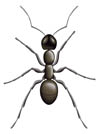
- Legs: Ants have six legs. Each leg has two sharp claws at the end that help the ant dig tunnels and climb walls and ceilings without falling. The front legs have a brush at the “elbow” that the ant uses to clean itself.
- Head: The head of an ant is where its eyes, mandible (jaw), and antennae are attached.
- Thorax: All of the ant’s legs are attached to this middle body section.
- Abdomen: Contains the stomach, a special place called the crop where the ant stores extra food, the intestines, and a poison gland.
- Antennae/Feelers: Ants use these to feel, smell, and taste objects. Each ant has two of them on the front of the head near the eyes.
- Mandible/Jaw: An ant uses its mandibles to carry objects and can also use them as a weapon during a fight. These jaws open and close sideways, like a pair of scissors.
- Eyes: Ants have compound eyes, which means they have many tiny eyes that make up two big eyes so they can see in many directions at once. However, ants really do not have very good eyesight. They rely mostly on their antennae to find their way around.
- Exoskeleton: Ants have a skeleton on the outside of their bodies instead of inside. They do not have skin like we do. The exoskeleton protects the ant almost as if it were wearing heavy armor!
Teach about the classification of animals. Use this section with the projects on temperature and ant food to help kids understand about differences between types of ants and about scientific classification.
Scientists use a system called classification to keep track of animals. This helps us learn about ants too. The system has seven levels. Animals are put into different levels based on their characteristics. Here are some examples of characteristics that are used in classification: has fur or skin, is warm-blooded or cold-blooded, has a backbone or not, lives in water or on land, and eats plants, animals, or both. (See if your children can come up with other characteristics that could be used in classification.)
The very last level of the classification system only has animals that all look and act almost identical. This level is called species (say spee-sheez or spee-seez). Here is an example: fire ants and carpenter ants are both ants, so of course they have a lot of characteristics in common. Fire ants and carpenter ants are also different in some ways, such as what they eat and where they live, so these two types of ants belong to two different species.
Teach about these and other ways that ants help out in nature:
- In their hunt for food, ants clean up the environment by removing dead bugs, leaves, and food items left behind by humans and animals.
- They eat harmful insects.
- The tunnels that ants dig in their nests allow more air to reach the soil.
Science Words to Learn About Ants
Antennae (say an-ten-ee) – Insects (including ants, of course!) and some other types of animals have a pair of stick-like feelers attached to their head. These are their antennae. They are the animal’s senses. Using its antennae, the animal or insect can smell, feel, taste, and possibly even hear!
Cold-blooded – A cold-blooded animal usually has a body temperature that is almost the same as the temperature outside, inside, or wherever the animal is located.
Warm-blooded – Of course, this is the opposite of cold-blooded and means that the animal has warm blood. Also, a warm-blooded animal’s body is not the same as the temperature around it. It stays at almost the same temperature all the time. A human’s normal body temperature is 98.6 ° F.