Color Chromatography
Chromatography is one of the simplest techniques for separating the individual components of a mixture. In chemistry, a mixture is a combination of substances that can be separated because they are not chemically bonded. As opposed to a compound, which has elements chemically bonded together. In paper chromatography, a mixture is dissolved and pulled across a piece of paper.
The mixture separates because its components travel across the paper at different rates, based on their attraction to the paper or solubility in the solvent. The word ‘chromatography’ comes from the two Greek words for ‘color’ and ‘writing.’ Once you try out the fun projects below, you’ll see why that’s such a fitting name!
>> Watch our chromatography video to see this cool process in action!
Color Hide-and-Seek
Is black really black? Let’s start with some simple paper chromatography to find out.
What You Need:
- Black washable marker
- Filter paper or coffee filter
- Beaker or cup
- Pencil
What You Do:
1. Cut a piece of filter paper or coffee filter into rectangular strips (approximately 1/2″ x 3-4″).
2. Draw a pencil line across the narrow end of a strip, about 1 cm from the bottom.
3. Draw a small dot with the black marker on the pencil line.
4. Use a binder clip or tape to attach the paper strip to a pencil. Set the pencil across the top of a beaker or cup. Adjust the paper strip until it hangs down without touching the sides or bottom of the beaker.
5. Carefully pour water into the beaker until it just touches the bottom of the paper strip. (Make sure the water level is below the marker spot, or else the ink will just run off into the water.) Water will begin to travel up the paper.
6. When the water nears the top of the paper, remove the strip from the beaker and let it dry on a paper plate or hanging in an empty cup. The series of colors you see is called a chromatogram.
What Happened:

As the water travels up the paper strip (similar to capillary action in plants), it dissolves the ink and pulls it up the paper too.
The black ink is actually a mixture of several different pigments, or coloring agents. Some pigments dissolve in water easier and are pulled with the water farther up the paper.
Others are more attracted to the paper and move more slowly.
Usually smaller molecules will move farther than larger ones. What colors do you see on your chromatogram? Was the black marker really black?
The three primary colors used when mixing dyes or paints are red, yellow, and blue.
Other colors are often a mixture of these three colors. Try running a chromatography test again with non-primary-color markers, like purple, brown, and orange.
See what hidden colors are really there! You can also try using other solvents, such as rubbing alcohol or nail polish remover, especially for permanent pens and markers that won’t dissolve in water.
| Featured Product Chromatography Experiment Kit 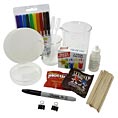 Chromatography is one of the simplest techniques for separating the components of a mixture – with this kit you can do 5 fun experiments to reveal the hidden colors in black ink, separate fall colors from green leaves, perform forensic chromatography, experiment with candy dyes, and more. |
Fall Colors in Summer Leaves
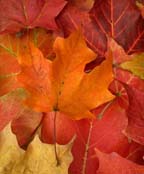 Every fall we watch amazing chemistry color changes happen all around us.
Trees that were green all year suddenly become bright yellow, orange, red, or even purple! How does this happen?
Leaves contain different pigments, which give them their color.
Green chlorophyll, which is essential for photosynthesis, is the most common type of pigment, but there are also cartenoids (yellow, orange, brown) and anthocyanins (red).
During the summer months, the leaves are so full of chlorophyll that green overpowers any other colors present in the leaves, such as yellow and orange.
In the fall the days start to get shorter and the temperature drops, signaling to the tree that it is time to go into storage mode for the winter. The chlorophyll starts to break down, causing the green in the leaves to disappear, and allowing us to see the colors of the other pigments, which were present all along.
You can use chromatography to find out what pigments are present in a leaf when it is still green.
What You Need:
- Green leaves (trees with dramatic fall color changes, like maples, work best)
- Filter paper or coffee filter
- Glass beaker or cup
- Rubbing alcohol
- Pencil
What You Do:
1. Gather several green leaves from a tree. You can choose to compare two different trees, if you want.
2. Cut the leaves into very small pieces and put them in a small glass or beaker.
3. Pour rubbing alcohol into the glass just enough to cover the leaves. You want the pigment solution to be as concentrated as possible, so don’t add more alcohol than necessary. Cover the glass with plastic wrap and set it in a larger glass or bowl with about an inch of hot water. Let it sit for at least 30 minutes, swirling occasionally and replacing the hot water as necessary. You can use a spoon to help crush the leaves and release more pigment.
4. When the color of the liquid is nice and dark, remove the leaf tissue with a fork or spoon (or strain it through a coffee filter).
5. Tape a strip of filter paper to a pencil and suspend it in the beaker so that the strip just touches the colored liquid. Cover the beaker with plastic wrap to prevent evaporation.
6. When the alcohol nears the top (this can take 30-90 minutes), remove the strip and let it dry.
What colors do you see in your finished chromatogram? The ‘hidden’? pigments (caretonoids and anthocyanins) will travel farther up the paper than the chlorophyll. Based on your chromatogram, what color do you think the leaves will be in the fall after the chlorophyll has broken down?
Read our article to learn more about how leaves change colors in the fall.
More Fun Chemistry Projects
Science Links
Explore the nature of color with this beautiful and informative web exhibit: Causes of Color.
Check out this site to see how all colored printing is really made from just four colors.