Insect Science Projects
Honey Bee Memory
Have you ever wondered how bees and butterflies know where to find good feeding spots? These insects don’t have sharp vision, but they see polarized light (which tells them direction based on where the sun is) and patterns of ultraviolet light on bright-colored flowers with lots of nectar. Bees also recognize man-made patterns; sometimes beekeepers put a symbol on a new hive so their bees can remember which is the right one.
Do this experiment to test how well bees recognize patterns – and see if you can fool them! You’ll need about a week to do this project, with time to check your homemade bee feeder every day.
What You Need:
- 5 index cards
- 5 small dishes
- 5 ziplock bags
- 1/4 cup sugar
- A black marker
- 3/4 cup water
What You Do:
1. On each of the index cards, draw a simple shape with the marker. (You might draw a star, circle, cross, triangle, and square.) Make the shape big enough to cover most of the card and fill in the shape so that it’s solid black. When you’re done, stick each card inside a ziplock. This will protect it from being ruined outside.
2. Set the bags outside in a flat, sunny spot where they won’t be disturbed. Make sure the shapes are facing up. Each one should be placed a couple feet away from the others. If you live in a windy area, use rocks or a stake to hold down the bags!
3. Mix up some sugar water, the “nectar” that will attract bees and other insects. (Real nectar, from flowers, is a similar sugary liquid.) Heat the water until it’s about to boil (the easiest way is to microwave it for 60-90 seconds). Then stir in the sugar until it’s dissolved. Pour the sugar water into one of the small dishes; fill the other four with plain water. Set a dish outside by each of the ziplocks. Make sure you remember which dish has the sugar water!
4. During the next few days, keep track of what kinds of insects visit the dishes. How many days does it take before bees find the one with sugar water? A few days after you’ve seen bees at the sugar water dish, switch cards so that the shape that was next to the sugar water is now by a dish of plain water. What happens in the next two days? Do the bees come right to the sugar water, or do they land on the dish with the card that used to be next to the sugar water? Now leave the cards where they are, but switch the sugar water dish with another dish of plain water. How do the bees respond?
Taking it further:
While you watch the bees’ reaction, keep an eye on other insects, too.
Do butterflies and ants respond the same way?
Did one kind of insect seem to have an easier time re-locating the sugar water? Try the experiment using different-colored circles, instead of different shapes.
Did any of the results change? Do insects seem to recognize colors as well as shapes?
Smelling Bee Activity
Despite having compound eyes, bees and ants don’t use their eyes the same way we do; in fact, some ants are blind! So instead of their sight, bees and ants often will rely on their sense of smell. Special scents called pheromones help them recognize each other and their homes. In this game, you’ll be the bee (or ant) and see if you can tell different scents apart.
What You Need:
- A variety of foods with various types of scents. A few easily recognizable options include: pickles, mustard, peanut butter, coffee beans, mint candy, banana, and vinegar.
- Cotton balls
- Handkerchief or other blindfold
- Film canisters or other small, opaque containers with lids, like empty single-serve yogurt containers.
Variation 1: Put a cotton ball soaked in the food (or a small portion of the food) in each container. Have the blindfolded children smell the container and see if they can guess the scent.
Variation 2: If playing the game with several children, divide each scent-soaked cotton ball into two containers. Pass them out to the children and have them take turns sniffing each others’ containers and try to find their “pheromone friend,” the person with the matching scent.
Variation 3: Make a smelling scavenger hunt. Hide a honey pot or honey bear and tell the children they must sniff their way back to the beehive. Make a trail of scent-filled containers that leads to the “hive.” Devise a “path” they must sniff out to in order to find their way back to the “hive.” Give the children directions to the hive using different scents to mark the trail. (Use pictures for younger children.)
- For kids in preschool through second grade, try out these other insect activities!
Insect Science Lesson
How Insects Communicate
Insects are everywhere, as you’ve probably noticed – especially when you’re trying to have a picnic without being invaded by ants or wasps or mosquitoes!
Insects account for 80% of the earth’s species, and come in astonishing varieties, from White Birdwing butterflies with 12-inch wingspans to the tiny Sri Lankan ant that measures only 1/30th of an inch. And while they may sometimes be picnic pests, insects are essential for our survival.
For example, without honeybees a large portion of the world’s crops would not be pollinated to produce food.
Have you ever seen a swarm of ants around a piece of food? How did they know it was there? How did the ant who found it tell all its friends? There’s still a lot that entomologists (scientists who study insects) don’t know about how insects communicate, but by careful observation they’ve been able to learn quite a bit.
Insects communicate by touch, smell, sound, and sight. The most important communication they have is with members of the same species; they use different signals to find mates, give warnings about danger, and tell about food sources. They also use signals to ward off predators or attract prey. Here are some of the ways bugs ‘talk’ to each other.
Touch
Some insects can’t see very well, and some live in dark places, so they need a method of communication that doesn’t depend on sight. They have to do something that another bug can feel. When an ant is ‘following a leader,’ it uses its antennae to tap the leader’s legs so the lead ant knows that its follower is keeping up with it. Other bugs send vibrations through the plant they are on to warn each other of approaching danger.
One of the most amazing examples of tactile (touching) communication is the honeybee dance language. When a honeybee finds a particularly good food source, it goes back to the hive and performs a figure-8-type dance that the bees close to it can feel. The dance tells the other bees approximately how far away the food is, and in what direction, based on the angle of the sun. This is the only instance entomologists have found of insects communicating abstract concepts! Have older students use this NC State University site to learn more about how it works and see an animated tutorial that illustrates how the date, time, and distance/direction of the food affects the bee’s dance. Does flower odor that the bees bring back with them also have a part to play in communicating where the food source is?
Smell
Insects have an incredible sense of smell. They can detect just a few molecules of a certain scent in the air. (Imagine if you had one drop of fruit juice in a gallon of water – do you think you could tell it was there by tasting or smelling? Insects have no problem smelling one ‘drop’ of their species’ special scent, even when is mixed in with a lot of air!) To communicate by smell within a species, insects release chemicals called pheromones. These special chemicals do many things, including marking trails and attracting mates. An ant who finds a food source leaves a pheromone trail as it heads back to the colony. As other ants come across the trail they follow it to the food source and leave another layer of pheromone on their way back. This makes the trail stronger and attracts even more ants.
Sometimes pheromones are released into the air, and insects smell them with their antennae. Other times they are released onto something – like a leaf or another insect – in which case the insect can taste the chemical with its feet. (That’s right…insects can taste things with their feet!)
Sound
From the buzzing of a bee to the whine of a mosquito to a cricket’s chirp, insects can make lots of sounds. Many times, these sounds are higher than human ears can hear. Insects can hear them with sensitive membranes called tymbals located on their abdomen or legs. Here are a few of the ways that insects make their own sounds (most of these humans can hear):
- Bugs like crickets and grasshoppers make sound by rubbing one part of the body (like a leg) against another (maybe a wing). This is called stridulation. You can think of it as kind of like playing a violin.
- Some insects, including cicadas, can make a very loud sound by vibrating a membrane on their body (their tymbal). A hollow part of their body cavity acts as a resonance chamber to amplify the sound. This works like a drum.
- Most insects breathe through tiny pores called spiracles. Some of them use these spiracles to make sounds, too. The Madagascar Hissing Cockroach, for example, pushes air out of its spiracles very fast to make a hissing sound.
- Bees and mosquitoes buzz when they fly because their wings vibrate fast enough to produce a sound.
To listen in on some insects, visit the USDA’s sound library.
Sight
If you’ve ever had the chance to look at a bug’s eye up close, you’ve probably noticed that it doesn’t look much like a human eye! Insects have compound eyes, made up of thousands of tiny lenses instead of just one like we have. These lenses don’t allow them to see very clearly, but they do make them highly sensitive to light and movement. When you sneak up behind a fly with the fly swatter, chances are it’ll see your movement and get out of the way before you can smash it!
Insects communicate visually in a passive way by their colorings and markings. After eating the poisonous Monarch butterfly, for example, predators avoid its orange and black coloring. The Viceroy butterfly looks almost identical to a Monarch, so predators avoid it too, even though it is safe to eat. Some moths have a different way of scaring off predators – they have marks on their wings that look like big eyes, threatening would-be attackers.
Visual communication isn’t just for avoiding predators, though. Fireflies have the ability to make their own light (this is called bioluminescence) and they use it to attract their mates. Each species has its own special signal with different numbers and lengths of flashes, kind of like Morse code. Usually the male firefly flashes his signal while he’s flying and the female flashes back from where she is sitting on some vegetation. Then the male will fly to her. He should be careful, though. One particular species of female firefly mimics the signal of another species and tricks the male into coming to her. When he does, she eats him!
For younger students: Help your young kids discover more about insects with our Insect Investigations for PreK-2 lesson plan.
Insect Camouflage
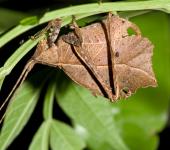 Is it a stick? Is it a leaf? What is it? If you’ve ever played capture the flag at night, you probably know that it’s best to wear dark clothes so you’ll blend in with the night. Light-colored clothing is easy to see in the dark, and if you wore it you’d end up getting captured, instead of capturing the flag! Insects are often in a real life and death game of hide and seek, and some are ‘masters of disguise’ to protect themselves. Their shapes and coloring help them blend into their surroundings so predators can’t see them. Some of them also use their camouflage so they can sneak up on their own prey.
Walking sticks are insects that look just like…sticks! You have to watch closely to pick them out from their surroundings. They can be several inches long (the largest, in southeast Asia, have been recorded at 13 inches) with bodies that blend in with the sticks and twigs in their natural habitat. Some even have the ability to change from green to brown to blend in better, like a chameleon.
Other insects in the same order as walking sticks (order Phasmida, meaning ‘phantom’) have flat, irregularly-shaped bodies and wings with venation so they blend in with leaves – some even look like dead leaves. Interestingly, the Phasmida are all leaf-eaters. Katydids are another group of bugs that look like leaves. Many have wings that are the same color as the leaves of the plant they live on. They can even ‘sway in the breeze’ like a real leaf.
Some bugs have weird appendages that fool their predators. Click here to see a picture of a bug that looks just like a thorn!
Not all bugs disguise themselves by their body shape. Lots of them just feature colors and patterns that match the background around them. Moths often have wing colors that look just like the tree they usually rest on. To demonstrate how this camouflage works, cut a few moth shapes out of a piece of paper. Look around your house for different colors and patterns. Decorate your moths with those colors and patterns (using markers, fabric, other paper, etc.) and then hide them in the area where they match. Hide one undecorated moth, too. See if someone else can find all the moths you hid. Does it take longer to find a decorated moth than the undecorated one?
Take a look at these stunning macro photographs of some unique and colorful insects.