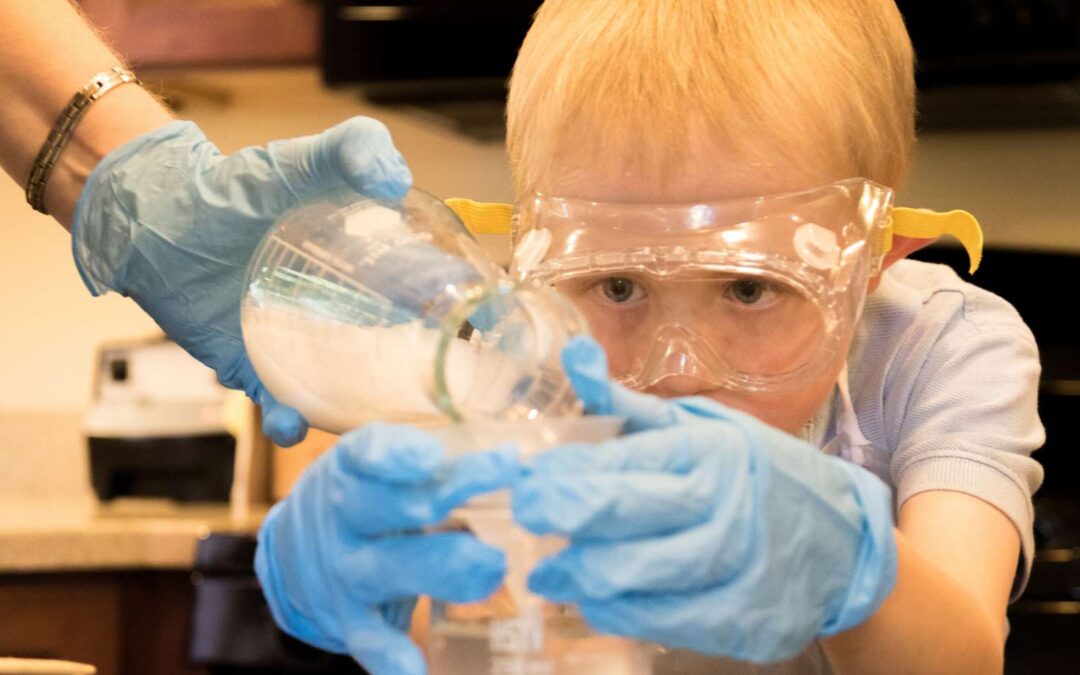
Learn all about owls – when they hunt, what they eat, how they can see and hear, and more!

Learn About Owls
Owl Eyes
 Explore how an owl’s eyes function differently than your eyes with this simple project. You will need a cardboard tube, such as one from a roll of toilet paper.
1. Cover one eye with your hand. Hold a pen or pencil about a foot in front of your face. (You can have a helper do this for you, if you want.)
2. Keep looking straight ahead while you start moving the pencil to the side. Even though your eye is facing forward, you should still be able to see the pencil out of the “corner of your eye.” Stop moving the pencil when you can’t see it anymore. How far did it get to the side before it disappeared?
3. Now, hold the tube up to one eye and look through it at the pencil in front of your face. Start moving the pencil to the side – how far did it get before it disappeared?
4. This time turn your head as the pencil moves so you can still see it through the tube. Stop when you get to the point where the pencil disappeared in step two. How much did you have to turn your head to see the pencil at that point?
Owls have two eyes, just like us. But the way they see is different. Because of their eyes, an owl can see much better in the dark than we can. However, an owl can only see straight ahead. This is why they need such flexible necks, so they can turn their entire head in nearly every direction. An owl’s eyes cannot move around like ours can. Try looking up, towards the ceiling, only moving your eyes. An owl would have to lift his head to do what you just did.
Our eyes are in front, on our face. But we can see to the side without moving our heads! This is called peripheral vision. Our eyes are able to take in a lot. What we see with both our eyes open is called the field of view. We have a wider field of view than owls do. When you held the tube up to one eye, it narrowed your field of vision. You were no longer able to see out of the “corner” of that eye. This is similar to how an owl sees all the time.
Owl Pellet Dissection
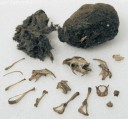 Owls are birds of prey, which means they hunt small animals like mice. Owls often swallow their meal whole, then spit out the fur and bones that can’t be eaten, and they come out in a small pellet, a little smaller than an egg. Dissecting an owl pellet is a good way to learn about the eating habits of birds of prey.
To do this project, you’ll need an owl pellet (if this is your first time doing this dissection, check out our Owl Pellet Dissection Kit; it’s perfect for beginners!). Look carefully at the outside of the pellet. How big is it? Can you see any feathers? Look for clues that tell you where the pellet was found. Guess how many different animal skeletons the pellet contains.
Next, gently pull apart the pellet, being careful not to break any of the bones inside it. Use toothpicks to separate the bones from the fur or feathers. Match the bones that you have found to a bone chart, to help you figure out which animal they belonged to. How many different kinds of animals did you find in the pellet? What does this tell you about where the owl lived?
Learn About Owls
What is an Owl?
 Owls, like other birds, have wings, beaks, and feathers. Birds also have a skeleton (made of lots of tiny bones) that is covered by feathers. There are many kinds, or species, of owls, but all are raptors, also called birds of prey. Birds of prey eat insects, fish, or small animals like mice, which they must find by hunting. Owls have many unique features that help them hunt. Most owls are nocturnal, meaning they hunt at night, though some hunt during the day. What an owl eats and where it lives depends on what type of owl it is.
Barn owls are large birds that hunt rodents like mice, voles, and rats, and may also eat small birds. This type of owl is nocturnal and in the day will make a home, or roost, in an empty building like a barn, or a hollow tree. They might also use the empty nest of another bird to hide away in. Barn owls will find a home near a field or marsh so they can hunt.
Screech owls are small, quick birds that hunt mostly insects. They make nests in trees, and their brown and gray feathers help camouflage them. These small owls are also nocturnal. Screech owls typically hunt from a perch by diving down and catching their prey with sharp talons and beak.
Horned owls can be found all across North America, from marshy wetlands to Arctic tundra. Horned owls are named because of the tufts of feathers that look like horns on top of their head. These birds are excellent nocturnal hunters. From a high perch, they dive down to catch rabbits or small rodents. They may also eat large insects, fish, lizards, and other birds.
Snowy owls are big birds with white feathers that make them blend in with snow. They make their homes in tundra, a cold land where little grows. They hunt mice, squirrels, rabbits, and other small animals. Their homes are in open plains, with a nest built on top of a rock or mound of dirt. Snowy owls hunt when it is light, usually in the morning or early evening.
Special Senses – Vision, Hearing, and Flight
Owls need to be able to see well since they are hunters. They have specially designed eyes that see in daylight as well as the dark. An owl’s eyes are large and bright, so they are able to gather light to see by even when it is nighttime. Our eyes work by reflecting (like what happens in a mirror) light, and then an image of what is reflected, or being seen, is created in our brains. Since owls’ eyes are so large, they are able to gather and reflect more light than we can. Owls do not have perfect vision at night, but they can see clearly. Not only are the owl’s eyes very large, but they are also close together in its flat face. That means that this bird can’t see to the side, unless it turns its head, while we are able to look up or to the side just by moving our eyes.
Owls can turn their heads nearly all the way around because of their flexible necks. Their heads aren’t able to spin around in a full circle, though. This is a unique feature that humans don’t have. The owl’s vertebrae are what allow it to see to the sides and behind. The bones in the neck and back are part of the vertebra. Humans (as well as most mammals) have seven bones (or vertebrae) in the neck. An owl has twice that! An owl’s 14 vertebrae in the neck allow it to rotate its head, seeing in nearly every direction, even though its body stays in the same spot.
Most owls are able to turn their heads halfway around a circle in either direction, meaning they can see straight behind by turning to the left or right. The great horned owl can turn its head even more than halfway, meaning it can turn its head to the right so it is looking straight back, then continue rotating so it is looking to the left. An owl can also tilt its head, so it is looking from upside down.
An owl has incredible hearing thanks to its unique ears. This, combined with excellent vision, helps the owl hunt. Our ears stick out from our head, but an owl’s are designed very differently. An owl hears with two ear holes that are behind its flat face, or face disc. The ear hole openings are covered in feathers at the side of the owl’s face. The face disc, because of its shape, lets sound flow into the feather-covered openings to the ear hole. An owl relies on its ears to be able to hunt.
Not only can owls hear sounds that are far away, but they can even tell how far away the sound is coming from, or where it is at. On many owls, the ear hole openings are placed so that one is higher than the other. Though the ear holes are evenly placed and balanced in the skull, the openings are specially designed so that an owl can hunt better, especially at night, the time when most owls go out. Having one opening to the ear hole higher than the other means that sound reaches each ear at a slightly different time, and the owl then can tell where the sound is coming from.
Owls can swoop through the air without making a sound, sneaking up on their prey. It is their specially designed feathers that make them able to do this. Most bird feathers are stiff and make a whoosh sound when the bird takes off or flaps its wings. An owl has feathers that are lighter and softer around the edges so that the owl can fly noiselessly. An owl’s body makes it a unique bird; one specially designed for hunting, especially at night.
What are Owl Pellets?
Owls’ beaks make it easier to catch a meal. Owls will often take their prey in their sharply pointed beak and then swallow it whole, without chewing like we do to break up food. An owl always eats quickly, so that larger animals don’t try to snatch away what they have caught, or even start attacking them. Owls survive by being sneaky birds.
Once the owl has swallowed its prey, its stomach starts breaking down the food, carrying it to all parts of the owl’s body. The stomach can break down (or digest) everything but the bones and feathers or fur of the owl’s last meal. The owl then spits out the parts that can’t be eaten, and they come out in a small pellet. Owl pellets can teach us a lot about where an owl lives and what it eats. Owl pellets are another special feature of this night hunter.
Printable Worksheet
Use this worksheet to make a food web showing what an owl eats. Kids can color the pictures and draw arrows from predator to prey.