A stretched rubber band is a great source of elastic potential energy. When released, that energy is converted to kinetic (motion) energy. The energy generated from the rubber band snapping back into shape is enough to power this small car.
Rubber bands can inflict pain if mishandled; adult supervision is recommended for children under 10.

Build a Rubber Band Car
What You Need:
Our Rubber Band Racecar Kit comes with everything you need to build a rubber band car.
(It also doubles as a balloon race car kit.)
To make this using your own materials, you’ll need:
- One car body (we recommend sturdy cardboard, foam board, or balsa wood)
- Several straws
- Two dowels (round pins that will fit inside the straws) for axles
- Four wheels (use plastic bottle caps, film canister caps, foam board, toy wheels such as K’nex, wooden wheels from a craft store, etc.)
- A handful of rubber bands
- Two small cup hooks
What You Do:
1. Cut a six-inch length of balsa wood to be the car body, or chassis. Cut a 1×1-inch notch out of one end. Your rear axle will be accessible through this notch.
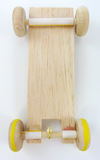
2. Cut two lengths of straw the same width as the chassis and glue or tape them across the chassis near each end. Trim away the center of the rear piece where it stretches across the notch in the chassis. Make sure the straws are lined up straight, or else the car won’t roll straight. (The picture to the right shows how it should look underneath the car.)
3. Cut both dowels one inch longer than the width of the chassis. Thread the dowels through the straws to create your axles. Slide a cup hook onto the rear axle so that it fits tightly in the center of the notch in the chassis. The screw will stick up to catch the rubber band. (If you don’t have the right-size cup hook, you can make a catch by wrapping an unfolded paperclip around the axle and securing it with hot glue.)
4. Attach your wheels to the axles. The wheels need to be a tight fit on the axle; if they aren’t, you may want to use hot glue to hold them in place.
5. Screw a small cup hook into the chassis just behind the front axle.
6. Choose a large rubber band to power the car. Loop one end on the hook at the front of the car, and loop the other end over the catch on the rear axle.
7. Your car is ready to roll! Turn the rear axle several times to wind the rubber band around it, set the car on a smooth hard surface, and let go! (Note: if your wheels are smooth, you might need more traction for the car to operate properly. Wrap rubber bands or loops cut from a small balloon around the rear wheels to add traction.)
What Happened:
The more you twisted the rubber band around the axle, the more potential energy you built up. When you let go, the rubber band snapped back to its original form, spinning the axle in the process. The potential energy in the stretched band was converted into kinetic energy propelling the car forward (the same energy transfer occurs in a mousetrap car).
Further rubber band car options:
You can always tweak the design of your car and see how that affects speed or efficiency (distance traveled).
Consider the following…
- Answer this, what effect does wheel size have on speed or efficiency?
- How about this, what effect does wheel size placement (e.g., larger wheels in back, smaller wheels in front) have on speed or efficiency?
- What effect does adding weight to your car (e.g., coins, washers, screws) have on efficiency?
- Lastly, what effect does making your chassis longer have on speed or efficiency?
Last thought. All cars move by kinetic energy.
So, then, why do real cars prefer gasoline (chemical energy) over rubber bands (elastic potential energy) to create kinetic energy?