Why do you need bones? Bones give your body support. Without them, you wouldn’t even be able to walk! Keep reading to find out how your bones and joints work together to allow your body to move.
Skeleton Projects & Bone Science
What Makes Bones Strong?
Even though bones are very light, they are also very strong.
However, how strong they are depends on how much of the mineral calcium carbonate they contain.
Do this experiment to find out how calcium carbonate affects bone strength. Make sure you get an adult to help you!
What You Need:
- Dried, clean chicken bone (a leg or wing bone)
- A glass
- White vinegar
What You Do:
1. Without breaking the bone, hold the bone and try to bend it – don’t force it to bend; or it will break! Notice how stiff the bone is.
2. Place the chicken bone in the glass and fill it with vinegar.
3. Let the bone soak for 2-3 days, then pour out the vinegar.
4. Add fresh vinegar and let it soak for about 2 more days.
5. After the 4th or 5th day of soaking, take the bone out and dry it off. Now try bending the bone without breaking it. What do you notice? How does it feel different from before you soaked it in vinegar?
What Happened:
Bones are made of calcium carbonate and a soft material called collagen. When the chicken bone was placed in the glass of vinegar, the acid in the vinegar dissolved the calcium carbonate so that only collagen was left.
Calcium (the mineral in calcium carbonate) is needed to make our bones strong. When there isn’t enough calcium, our bones become soft and are more likely to break.
The soft collagen simply isn’t strong enough to support our bodies on its own. But don’t worry, the acid found in some food and drinks won’t destroy your bones. Just make sure you eat plenty of foods that have calcium in them!
A few foods that contain a lot of calcium are milk, cheese, soy products, beans, almonds, and orange juice.
What Makes Your Back Flexible?
What gives you the ability to bend, twist, run, or skip? Does having a lot of bones or just a few bones in your body make you more flexible? Try this experiment and find out! Make sure you have an adult help you.
What You Need:
- Drinking straw
- Pipe cleaner
- Scissors
What You Do:
1. Thread the pipe cleaner through the straw. Then gently try to bend the pipe cleaner where it is covered in the straw. Does the pipe cleaner bend much?
2. Take the pipe cleaner out of the straw and cut the straw into pieces that are about one inch long. Thread the pieces of the straw onto the pipe cleaner so that they are touching each other.
3. Now gently bend the pipe cleaner again. How easily does it bend?
What Happened:
The pipe cleaner and straw are representing how joints allow our bodies to move.
When the straw was in just one long piece, it was representing one long bone, such as our thigh bone or upper arm bone.
These bones can’t bend because there is no joint there to allow that to happen. Instead, these solid bones give our bodies stability. But when the straw was cut in pieces and then placed on the pipe cleaner, it was very easy to bend because of the “joints” created by the cuts in the straw.
A joint is where two or more bones meet.
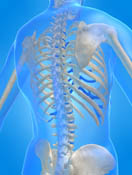
The small pieces of straw stacked on top of each other are very similar to how our bodies’ backbone is structured.
Your spine is made up of small bones stacked on top of each other with the spinal cord threaded through them.
Like the pipe cleaner, you can bend your back forward and backward, side to side, and even rotate in a circle. The stacked bones are not very stable though, so your back has strong muscles to help keep your spine straight.
Your body has a lot of other joints too – bend your arms and legs, wiggle your fingers and toes, sit down, reach up high, and look from side to side.
It is possible for you to move your body in all of these ways because of joints in your fingers, ankles, knees, hips, elbows, neck, and everywhere else that bones connect inside of your body!
Skeletons & Bones Science Lesson
Have you ever seen a house or a building while it is being built? If so, you may have noticed long wooden or steel beams being constructed before the outside walls are added.
These beams make up the framework of the building, very much like the way that your bones form your skeleton.
Both frames provide shape, strength, and protection – your bones for your body and the beams for the building. However, unlike the framework in a house, bones are alive!
Your bones will continue to grow inside your body until you are around 25 years old!
Bones can also repair themselves. Small cracks form in bones all the time from bumping into objects and doing strenuous activities like running and jumping.
But these cracks are rarely noticed by us because they are repaired quickly by special bone cells called osteoclasts (say OS-TEE-O-CLASTS) and osteoblasts (say OS-TEE-O-BLASTS).
These cells also repair major breaks in the bone. A doctor may need to help set the broken bone in place, but the bone will usually heal itself in about 6-8 weeks.
Bones are very strong, but are also amazingly lightweight!
Bones are wrapped in a thin covering called the periosteum (say PER-EE-OS-TEE-UM). The periosteum supplies nutrients to the bones to keep them strong and healthy. Beneath this is a hard layer called compact bone. It provides most of the strength for the bone.
Inside the bone is a “spongy” material. It has lots of holes and gaps in it to make your bones lightweight and also allow for the production of red blood cells.
Based on their shape, bones can be classified as long, short, flat, or irregular.
(FYI: bone fossils give us clues about animals that may have lived long ago.)
Long bones are easy to spot because they are longer than they are wide. Finger bones, arm bones, and leg bones are all good examples of long bones.
Short bones tend to look like a cube. The bones in your wrists and ankles are short bones.
Flat bones are thin and look flattened. Examples include the sternum (the bone down the middle of your chest that your ribs are connected to), shoulder blades, and the pelvic (hip) bones. Irregular bones have weird shapes and can be found all over the body. The bones in the spinal column are irregularly shaped.
Since bones cannot bend without breaking, something else is needed to allow your body to move – joints.
A joint is where two or more bones meet and allows movement between those bones. How much movement can occur depends on the type of joint. Here are some different joints that exist in your body:
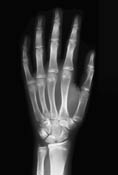
- Hinge joint: To demonstrate a hinge joint, open a door and then close it. Notice where the door is attached to the wall and the movement is occurring. This is called a hinge and is very similar to how the joints in your fingers move (not the joints attaching your fingers to your palm though). Bend your fingers. Notice how the knuckles only allow the sections of your fingers to move inward towards your palm – not side-to-side or backwards. Your knees are another example of hinge joints.
- Saddle joint: This joint works like a hinge joint but has slightly more flexibility. A prime example of a saddle joint is where your thumb meets your palm. It can move forward and backward and side to side, allowing you to grasp objects between your thumb and fingers.
- Pivot joint: This joint allows rotating movement. The two bones in your forearm connected to your elbow form a pivot joint. To see how this works, open a door using a door knob. Notice how not just your hand, but the whole lower part of your arm rotates to twist the knob.
- Ball and socket joint: To demonstrate how this joint works, make a fist with one hand, and then cover it with the other. Notice how the fist can move freely in a full circle. A ball and socket joint works the same way – it allows the part that fits into the joint to move without restraint. Ball and socket joints are in your shoulders and your hips and have the most flexibility of any type of joint. On a side note, most animals that walk on four legs, like dogs and cats, don’t have shoulders with ball and socket joints. This is because the flexibility of ball and socket joints makes the shoulder and arm bones less stable. These animals have shoulder joints that are more similar to hinge joints to increase their stability and allow them to run very fast on all four legs.
Skeleton Projects Printable Worksheet
Use the skeleton projects worksheet to help children learn the major bones in the skeletal system.
They can match each bone to the correct name and then make a paper skeleton model by cutting out each bone and putting the pieces together.