Our skin acts as the protective barrier between our internal body systems and the outside world. It’s not only the body’s largest sensory organ, but it’s also the largest organ–period!
The skins “sense of touch” is what gives our brains a wealth of information about the natural environment, including temperature, humidity, and air pressure.
Most importantly, this sense of touch lets us feel physical pain–a necessity for avoiding injury, disease, and danger.
It is truly amazing how much information we receive about the world through our sense of touch, and although we still don’t know all the ins and outs of how the skin perceives touch, what we do know is interesting.
Skin Science Lesson
-Skin Anatomy
-Somatosensory System: The Ability To Sense Touch
-Nerve Signals: Making Sense of It All
Skin Anatomy
The skin is composed of several layers. The very top layer is the epidermis and is the layer of skin you can see. In Latin, the prefix “epi-” means “upon” or “over.” So the epidermis is the layer upon the dermis (the dermis is the second layer of skin). Made of dead skin cells, the epidermis is waterproof and serves as a protective wrap for the underlying skin layers and the rest of the body. It contains melanin, which protects against the sun’s harmful rays and also gives skin its color. When you are in the sun, the melanin builds up to increase its protective properties, which also causes the skin to darken. The epidermis also contains very sensitive cells called touch receptors that give the brain a variety of information about the environment the body is in.
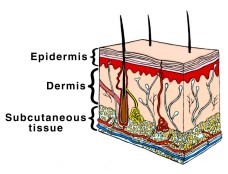
The second layer of skin is the dermis. The dermis contains hair follicles, sweat glands, sebaceous (oil) glands, blood vessels, nerve endings, and a variety of touch receptors. Its primary function is to sustain and support the epidermis by diffusing nutrients to it and replacing the skin cells that are shed off the upper layer of the epidermis. New cells are formed at the junction between the dermis and epidermis, and they slowly push their way towards the surface of the skin so that they can replace the dead skin cells that are shed. Oil and sweat glands eliminate waste produced at the dermis level of the skin by opening their pores at the surface of the epidermis and releasing the waste.
The bottom layer is the subcutaneous tissue which is composed of fat and connective tissue. The layer of fat acts as an insulator and helps regulate body temperature. It also acts as a cushion to protect underlying tissue from damage when you bump into things. The connective tissue keeps the skin attached to the muscles and tendons underneath.
Somatosensory System: The Ability To Sense Touch
Our sense of touch is controlled by a huge network of nerve endings and touch receptors in the skin known as the somatosensory system. This system is responsible for all the sensations we feel – cold, hot, smooth, rough, pressure, tickle, itch, pain, vibrations, and more. Within the somatosensory system, there are four main types of receptors: mechanoreceptors, thermoreceptors, pain receptors, and proprioceptors.
Before we dig further into these specialized receptors, it is important to understand how they adapt to a change in stimulus (anything that touches the skin and causes sensations such as hot, cold, pressure, tickle, etc). A touch receptor is considered rapidly adapting if it responds to a change in stimulus very quickly. Basically this means that it can sense right away when the skin is touching an object and when it stops touching that object.
However, rapidly adapting receptors can’t sense the continuation and duration of a stimulus touching the skin (how long the skin is touching an object). These receptors best sense vibrations occurring on or within the skin. A touch receptor is considered slowly adapting if it does not respond to a change in stimulus very quickly. These receptors are very good at sensing the continuous pressure of an object touching or indenting the skin but are not very good at sensing when the stimulus started or ended.
- Mechanoreceptors: These receptors perceive sensations such as pressure, vibrations, and texture. There are four known types of mechanoreceptors whose only function is to perceive indentions and vibrations of the skin: Merkel’s disks, Meissner’s corpuscles, Ruffini’s corpuscles, and Pacinian corpuscles. The most sensitive mechanoreceptors, Merkel’s disks and Meissner’s corpuscles, are found in the very top layers of the dermis and epidermis and are generally found in non-hairy skin such as the palms, lips, tongue, soles of feet, fingertips, eyelids, and the face.
Merkel’s disks are slowly adapting receptors and Meissner’s corpuscles are rapidly adapting receptors so your skin can perceive both when you are touching something and how long the object is touching the skin. Your brain gets an enormous amount of information about the texture of objects through your fingertips because the ridges that make up your fingerprints are full of these sensitive mechanoreceptors. Located deeper in the dermis and along joints, tendons, and muscles are Ruffini’s corpuscles and Pacinian corpuscles. These mechanoreceptors can feel sensations such as vibrations traveling down bones and tendons, rotational movement of limbs, and the stretching of skin. This greatly aids your ability to do physical activities such as walking and playing ball.
- Thermoreceptors: As their name suggests, these receptors perceive sensations related to the temperature of objects the skin feels. They are found in the dermis layer of the skin. There are two basic categories of thermoreceptors: hot and cold receptors.
Cold receptors start to perceive cold sensations when the surface of the skin drops below 95 ° F. They are most stimulated when the surface of the skin is at 77 ° F and are no longer stimulated when the surface of the skin drops below 41 ° F. This is why your feet or hands start to go numb when they are submerged in icy water for a long period of time.
Hot receptors start to perceive hot sensations when the surface of the skin rises above 86 ° F and are most stimulated at 113 ° F. But beyond 113 ° F, pain receptors take over to avoid damage being done to the skin and underlying tissues. Thermoreceptors are found all over the body, but cold receptors are found in greater density than heat receptors. The highest concentration of thermoreceptors can be found in the face and ears (hence why your nose and ears always get colder faster than the rest of your body on a chilly winter day).
- Pain receptors: The scientific term is nocireceptor. “Noci-” in Latin means “injurious” or “hurt” which is a good clue that these receptors detect pain or stimuli that can or does cause damage to the skin and other tissues of the body. There are over three million pain receptors throughout the body, found in skin, muscles, bones, blood vessels, and some organs.
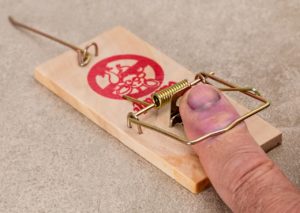
They can detect pain that is caused by mechanical stimuli (cut or scrape), thermal stimuli (burn), or chemical stimuli (poison from an insect sting).These receptors cause a feeling of sharp pain to encourage you to quickly move away from a harmful stimulus such as a broken piece of glass or a hot stove stop. They also have receptors that cause a dull pain in an area that has been injured to encourage you not to use or touch that limb or body part until the damaged area has healed. While it is never fun to activate these receptors that cause pain, they play an important part in keeping the body safe from serious injury or damage by sending these early warning signals to the brain.
- Proprioceptors: In Latin, the word “proprius” means “one’s own” and is used in the name of these receptors because they sense the position of the different parts of the body in relation to each other and the surrounding environment. Proprioceptors are found in tendons, muscles, and joint capsules. This location in the body allows these special cells to detect changes in muscle length and muscle tension. Without proprioceptors, we would not be able to do fundamental things such as feeding or clothing ourselves.
While many receptors have specific functions to help us perceive different touch sensations, almost never are just one type active at any one time. When drinking from a freshly opened can of soda, your hand can perceive many different sensations just by holding it.
Thermoreceptors are sensing that the can is much colder than the surrounding air, while the mechanoreceptors in your fingers are feeling the smoothness of the can and the small fluttering sensations inside the can caused by the carbon dioxide bubbles rising to the surface of the soda.
Mechanoreceptors located deeper in your hand can sense that your hand is stretching around the can, that pressure is being exerted to hold the can, and that your hand is grasping the can. Proprioceptors are also sensing the hand stretching as well as how the hand and fingers are holding the can in relation to each other and the rest of the body. Even with all this going on, your somatosensory system is probably sending even more information to the brain than what was just described.
Nerve Signals: Why You Have a Sense of Touch
Of course, none of the sensations felt by the somatosensory system would make any difference if these sensations could not reach the brain. The nervous system of the body takes up this important task. Neurons (which are specialized nerve cells that are the smallest unit of the nervous system) receive and transmit messages with other neurons so that messages can be sent to and from the brain. This allows the brain to communicate with the body. When your hand touches an object, the mechanoreceptors in the skin are activated, and they start a chain of events by signaling to the nearest neuron that they touched something. This neuron then transmits this message to the next neuron which gets passed on to the next neuron and on it goes until the message is sent to the brain. Now the brain can process what your hand touched and send messages back to your hand via this same pathway to let the hand know if the brain wants more information about the object it is touching or if the hand should stop touching it.
Sense of Touch Projects
-Is the Glass of Water Hot or Cold?
-Two-Point Discrimination
Is the Glass of Water Hot or Cold?
With this experiment, test your skin’s ability to perceive whether an object is hot or cold.
What You Need:
- Three tall glasses of water, one filled with very warm or hot water (not burning), one filled with room-temperature water, and one filled with ice water
- A clock to time yourself
What You Do:
1. Grab the glass of hot water with one hand, making sure that your palm is touching the glass. Grab the glass of ice water with your other hand, holding the glass in a similar fashion.
2. Hold the glasses for at least 60 seconds.
3. After holding the hot and cold glasses for 60 seconds, grab the room-temperature glass with both hands, palms touching the glass.
4. Does the glass of room-temperature water feel hot or cold?
What Happened:
Your brain just received confusing messages from your hands about what the temperature of the third glass was. The hand originally holding the hot glass told you the third glass was cold, whereas the hand originally holding the cold glass told you the third glass was hot. But they were both touching the same glass. How can this be?
You received these confusing messages because our skin does not perceive the exact temperature of an object. Instead, your skin can sense the difference in temperature of a new object in comparison to the temperature of an object the skin was already used to (“relative temperature”). This is why entering a body of water, such as a pool or lake, seems really cold at first (your body was used to the warmer air) but then gradually “warms up” after being in the water for a while (your body adjusts to the temperature of the water).
Two-Point Discrimination
Is your skin equally sensitive all over your body? Try this experiment to find out more about how well your skin perceives touch.
What You Need:
- Ruler that measures in millimeters
- Two toothpicks
- Partner
- Blindfold (optional)
What You Do:
| 1 mm | 2 mm | 3 mm | 4 mm | 5 mm | 10 mm | |
| Tip of Finger | ||||||
| Palm of Hand | ||||||
| Upper Arm | ||||||
| Back | ||||||
| Cheek |
1. Prepare for this activity by setting up a chart like the one listed above. You may need to go beyond 10 mm in this activity, and you may want to test more areas of the body than what is listed. Some suggestions are: back of finger, back of hand, wrist, neck, stomach, top of foot, sole of foot, calf, thigh, forehead, nose, lip, and ear.
2. Explain to your partner that you are going to lightly poke her with either one or two toothpicks on various places on her skin. Her job is to tell you whether or not she feels one poke or two pokes. To make sure she is not cheating, she needs to either wear a blindfold or keep her eyes closed.
3. Without telling your partner this, hold the two toothpicks so that the points measure 1 mm apart and lightly poke her on the palm of her hand. Ask her if she felt one or two points on her skin. If she says one point, separate the two points of the toothpicks so that they measure 2 mm apart and lightly poke her in the palm again. Keep pulling the points apart until she says that she feels two points. Record the measurement at which she felt points on the palm of her hand.
4. Repeat step 3 with other parts of the body, such as the fingertips, the upper arm, the back, the stomach, the face, the legs, and feet. Make sure to record the smallest distance at which each area of the body felt two distinct points when poked with the toothpicks.
What Happened:
The ability to distinguish between one point or two points of sensation depends on how dense mechanoreceptors are in the area of the skin being touched. You most likely found that certain areas of your body are much more sensitive to touch than other areas. Highly sensitive areas such as the fingertips and tongue can have as many as 100 pressure receptors in one cubic centimeter. Less sensitive areas, such as your back, can have as few as 10 pressure receptors in one cubic centimeter. Because of this, areas such as your back are much less responsive to touch and can gather less information about what is touching it than your fingertips can.
Try these projects next:
Explore hands-on science with one of these top-selling kits. Do an easy blood type test to find your blood type, learn medical practices with a suture kit, explore the power of the sun with a fun solar cars kit, discover the world of marine life by dissecting a preserved starfish, and for the high school homeschooler, do a human body lab with Apologia’s AP Biology Curriculum.