How do you tell the difference between a reptile and an amphibian? To help your young children understand the similarities and differences between reptiles and amphibians, make a chart. For older elementary and junior high kids, let them create charts listing differences between different kinds of reptiles or amphibians (e.g., how is a frog different from a salamander?).
Since reptiles and amphibians can be hard to observe in the wild, take a field trip to a zoo or pet store. You might call ahead to see if your kids will be allowed to handle any of the animals. Before you go, ask younger kids what they think a snake feels like. What about a frog? A turtle? Will a frog or a snake feel more ‘slimy’? After the visit, discuss the experience. Encourage older kids to investigate feeding habits, make sketches, observe how the animal moves, etc.
If you are handling frogs in the wild, be sure that you have wet hands or hold the animal with a plastic bag. Your bare hands can quickly cause the frog’s skin to dry out. After touching any amphibian or reptile, be sure to wash your hands well with soap and water!
To find out more about frogs, do research on one of these topics: what kinds of frogs live in your area? Can you find more than one species of tadpole locally? If so, compare them. What do local frogs eat? How would the mosquito population be affected if there were few or no frogs in a swampy region? Pick a frog or frog characteristic that is interesting to you, and see what you can find out about it. Look for close-up frog pictures in a magazine like National Geographic or on a website.
Comparing Frogs & Snakes
To see for yourself how an amphibian and reptile differ, examine the external anatomy of two species such as a frog and a snake. You can observe the external anatomy of live ones at a pet store. Or do an online image search: try ‘bufo’ (part of the scientific name for some frog species), ‘bullfrog,’ ‘poison dart frog,’ ‘tree frog,’ ‘garter snake,’ ‘elipidae’ (the main family of venomous snakes), ‘colubridae’ (the family with common snakes), and ‘boidae’ (constrictors).
This is just an overview of some features of frogs and snakes – there’s a lot more to learn about them!
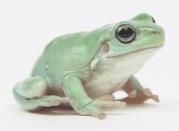 Skin & scales: How does the skin of a frog look (and feel) compared to a snake or other reptile? One is typically smooth and moist, one is dry and scaly. Frogs can exchange oxygen and carbon dioxide through their skin. They have mucous glands that secrete a waterproof coating to keep their skin moist and slippery.
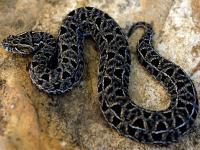
Snakes have a tough coating of scales made of keratin, the same protein that forms your hair and fingernails. Each species either has smooth scales or rougher keeled ones, with a unique pattern of scales and coloring. They also have long horizontal scales on their belly that help them move across surfaces. Both frogs and snakes (as well as other reptiles) molt, or shed their skin. Frogs change their skin about once a week! Although all reptiles shed their skin as they grow, snakes lose their skin in a whole piece rather than pieces flaking off.
- Head & mouth: Sensory organs on frogs and snakes differ quite a lot. Frogs have bulging eyes that provide them a wide range of view. Snakes, on the other hand, generally have poor vision. Frogs have a tympanic membrane that can detect sound waves in water or the air and transfer the sound to the inner ear. Snakes have no external ear openings, but they can pick up vibrations through their jaw bones, which transfer to their internal ear bones.
Frog tongues are broad and specially attached so they can be thrust out and catch insects. Snake tongues are narrow and forked, to ‘taste’ chemical particles in the air.
Respiration:
- Frog tadpoles breathe through gills in the water, but adult frogs get oxygen through wet skin and their lungs. Watch a frog closely and you can see its throat moving in and out as it breathes. Snake respiration is unusual, too. The left lung in most snakes – except boas and pythons – is very small or else absent. They do fill their right lung with air, however.
- Feeding: Snakes and frogs are both carnivorous – they eat ‘meat,’ ranging from tiny insects to large mammals. Many frogs have two raised bumps in the roof of their mouth, vomerine teeth, plus a bony ridge in their gums. The roof of a snake’s mouth is covered with rows of tiny teeth to help it grasp its prey so it can swallow it whole. Some species have more than 200 teeth! (Neither reptiles nor amphibians really use their teeth to chew – even alligators and crocodiles swallow their food down whole or in large pieces!). Snakes’ jaws are also hinged so that they can open their mouths wide enough to swallow their food whole.
 Limbs & movement: Frogs have webbed feet (perfect for swimming) and their back legs are much stronger than their forelegs, because they are designed for swimming and jumping.
- With their powerful legs, frogs can leap 20 times their body length! Tree frogs also have suction cups on their toes that allow them to cling to the bark of tress. Snakes do not have limbs, but their bodies are still designed for movement. Large, heavy snakes use rectilinear movement, traveling in almost a straight line by pulling themselves along with their scales. Other snakes travel by S-shaped serpentine motion or throwing themselves along by sidewinding. Tree-climbing snakes use concertina movement, bunching up one end of their body to propel themselves forward. The fastest snake in the world, the black mamba, can move at 10-12 miles per hour!
- Reproduction: Snake eggs are more like chicken eggs than like the spawn of frogs and other amphibians. Amphibian eggs lack a shell or other hard protective layer. The female usually lays hundreds or thousands of eggs in the water, which the male fertilizes. Although both kinds of animals ‘hatch,’ some kinds of snakes keep their eggs inside their bodies until the babies are born and slither out of the birth opening.
- Skeleton: Both amphibians and reptiles have a backbone. Most frogs have no ribs, however. Depending on the species, a snake will have between 180 and 400 vertebrae and almost as many ribs!
- Defenses: Different snakes have different venoms made up of toxins that affect their victims in different ways. There are some toxins that attack the nervous system, and same that destroy cells, damage the heart, or affect red blood cells. Other snakes, constrictors, kill their prey by grabbing it with their mouth and then coiling their body around so tightly that the prey can no longer breathe. Frogs secrete poison in their skin, although only some species are toxic to people. Some also have the ability to ‘spit’ poison at predators or prey. Usually the most toxic frogs are brightly colored, to warn off predators. Other frogs have camouflage skin colorings that help them to blend in with their surroundings. Special pigment cells in their skin control the camouflage pattern and colors.
Have you ever wondered how frogs breathe? When under water, frogs get their oxygen from water that passes through their skin. Capillaries take the oxygen from the skin into the bloodstream. On land, frogs usually get oxygen by taking air through their throats into saclike lungs.
Science Links
See how their surroundings cause cold-blooded animals’ temperatures to adjust! This page has infrared images of animal body temperatures.
Visit the reptiles and amphibians page at the Smithsonian Zoo for facts and pictures.
Many countries have more than 1-2 kinds of crocodilians, shown on this species map.
Search for amphibian species by country.