
Science Projects
Make a Solar System Model
Make your own model of the solar system! It will help you learn the order that the planets orbit around the sun.
What You Need:
- Yellow construction paper
- Scissors
- Coloring page
- Colored pencils
What You Do:
1. Ask a parent or your teacher to read to you about the planets from the Science Lesson at the end of this newsletter. This will help you learn about the physical characteristics of each planet (like how big it is and what its surface is like) and the order of the planets.
2. Print out this coloring page of the eight planets.
3. Based on what you learned about the size and surface of the planets, figure out which planet is which and then color the planets the right colors.
4. Cut out a large circle from the yellow construction paper to be the sun.
5. Placing the sun down first, lay out the planets in order away from the sun. (Hint: The correct order that the planets orbit around the Sun is: Mercury, Venus, Earth, Mars, Jupiter, Saturn, Uranus, and Neptune!)
6. To make your model of the solar system more permanent, glue the sun and planets onto a large piece of cardboard or tag board. You could even paint the board black to make it look like space.
What Happened:
You just made a model of the solar system! It represents the way the planets are positioned and the different sizes and colors that each one is. The planets always remain in this order; they can’t change because they all have their own orbit that they constantly follow around the sun! However, this model does not show you how far apart the planets are from each other. They are so far away that you would not be able to represent the distance on a single piece of cardboard.
To learn more, use this site as a guide to make a scale model of the solar system. Even though your scale model will only be a fraction of the size of the actual solar system, it will give you a better idea of how big it really is and how much space is out there!
Here is another project: try making your own simple telescope to get a better view of the moon and stars.
The Color of Mars
What causes the different colors of the planets? Scientists have theories (guesses based on what they have seen and learned) about why a planet is a certain color, but often they don’t know what causes the colors of the planets, especially the planets that are farthest away from us. Try this experiment to demonstrate one of the theories about why Mars has such a red surface.
What You Need:
- Sand
- Ceramic or glass baking dish
- Steel wool or iron filings
- Scissors
- Water
What You Do:
1. Put a layer of sand in the bottom of the baking dish.
2. Cut the steel wool into 1 inch pieces with the scissors and mix the pieces with the sand. (Or, instead of using steel wool, you can sprinkle iron filings on top of the sand.)
3. Cover the mixture with water and check it every day to see if you notice any changes.
4. As water evaporates from the dish, add more so that the sand is always wet.
What Happened:
After a few days, you should notice the sand starting to turn red. This happens because the oxygen in the water combines with the iron in the steel wool or the iron filings. This caused a chemical reaction that produced iron oxide, which is also known as rust. As you can see from your experiment, rust has a red color to it. Scientists think that the surface of Mars is red because there is iron oxide (rust) in the soil.
Science Lesson
The Sun and the Solar System
Did you know that the sun is actually a star? It is the closest star to the Earth, which is why it seems so big and bright. Compared to some stars though, the sun is really only medium sized! Any star that has planets and other celestial bodies orbiting around it can be called a solar system. The Earth, other planets, their moons, various stars, comets, and asteroids that revolve around the sun are all part of our solar system. The word ‘sol’ means sun, so our solar system could be called a sun system. Why is the sun so important? Without the light, heat, and energy that comes from it, the Earth would be so cold that no living thing would be able to survive on it! And the sun’s gravity keeps the Earth and the rest of the planets moving in their orbits – without it, the planets would move randomly through space like comets. Even though our solar system is huge, it is a very small part of a much larger system called the Milky Way galaxy. Even the whole galaxy is small compared to what else is out there – there are many galaxies in the universe with many other solar systems in them!
The Planets
A way to remember the order of the planets is the saying: My Very Educated Mother Just Served Us Nine Pizzas. Though, with the recent removal of Pluto from the list of true planets, this could be changed to something like My Very Educated Mother Just Served Us Noodles. An easy way to help children learn about the eight planets is to split them into two groups: the four small rocky planets and the four giant gas planets.
The Small Rocky Planets
The small rocky planets are also the four inner planets (the ones closest to the sun): Mercury, Venus, Earth, and Mars. These planets are all made of rock and have a solid surface.
Mercury is the planet closest to the sun, and it is the smallest of the eight planets. Because it is so close to the sun, from Earth it can only be seen at sunrise in the east and sunset in the west. This makes the planet seem like it is moving quickly across the night sky and is probably the reason why it got its name – Mercury is the Roman god of trade, travel, and thievery and was known for his speed. The temperature on Mercury ranges from 801 ° F on the side facing the sun to -279 ° F on the side facing away from the sun. The lack of atmosphere on Mercury means that we can see its surface directly, which is gray in color and is covered with craters.
What is an atmosphere? It is a layer of gas that surrounds a planet. When the layer of gases moves around the planet, it causes changes in a planet’s temperature and weather. For example, Earth’s atmosphere helps insulate it to keep it in a certain temperature range so that it does not get too hot or too cold.
Venus is the second planet away from the sun and is named after the Roman goddess of love and beauty. It probably received this name because it is one of the brightest objects in the night sky, second only to our moon! Venus has often been referred to as Earth’s sister planet because they are similar in size (Earth is slightly larger), density, and gravity. Venus also has active volcanoes and earthquakes, but here the similarities end. The atmosphere on Venus is made out of sulfuric acid, a poisonous gas, and causes the planet to retain heat very well – the temperature stays constant at about 864 ° F! The thick clouds of Venus gives it a pale yellow color, but beneath the clouds, it appears that the surface is red and yellow.

Earth is the third planet from the sun and is the only planet that was not named after a Roman deity. The largest of the inner planets, it has often been called the ‘Big Blue Marble’ because its surface is covered with over 70% water. The atmosphere and swirling clouds over the white, brown, and green colors of the land and the blue of the oceans makes for a kaleidoscope of colors when viewed from space. Earth is also referred to as the ‘Goldilocks’ planet because it has all the ingredients in just the right amount to sustain life – water, oxygen, and a comfortable temperature range.
Mars is the fourth planet from the sun and is the second smallest planet. It is named after the Roman god of war and probably received this name because it shines red in the sky. Up close, the surface of Mars is bright reddish brown with dark patches of gray in the volcanic regions. Because of its red color, Mars is often nicknamed ‘The Red Planet.’
The Giant Gas Planets
There are four outer planets: Jupiter, Saturn, Uranus, and Neptune. These planets are often called the gas giants. Unlike Earth, they do not have a solid surface, but rather are made mostly of helium and hydrogen with a small, rocky core in the center. The giant gas planets all have ring systems and numerous moons.
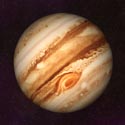
Jupiter is the fifth planet from the sun and is named after the king of the Roman gods. This is a very fitting name since it is the largest planet in our solar system. The gases and clouds in Jupiter’s atmosphere make colorful orange, white, red, and yellow bands on the planet. Its most famous feature is the Great Red Spot which is a giant storm similar to a hurricane on Earth. This storm is so large that 2-3 Earths could fit inside of it.
Saturn is the sixth planet from the sun and is the second largest planet in our solar system. Saturn is named after the Roman god of agriculture (farming). Even though Saturn is so large, it doesn’t weigh very much. In fact, it is less dense than water, meaning it would float on water. The most famous feature of Saturn is its beautiful rings. The rings are made of billions of chunks of ice and rock, though from Earth they look solid. The overall color of Saturn is yellowish, but its storms cause faint bands of color to appear in its atmosphere.
Uranus is the seventh planet from the sun and is the third largest planet in the solar system. Unlike the first six planets which were known to ancient civilizations, Uranus was not discovered until 1781. Uranus was named after the ancient Greek god of the heavens. Its atmosphere has small amounts of methane in it, giving it a solid blue-green color and a less exciting surface compared with the other planets. But unlike them, Uranus is tilted so much that it actually spins on its side as it orbits the sun.
Neptune is the eighth and farthest known planet from the sun and is the fourth largest planet in the solar system. Neptune was discovered in 1846 and named after the Roman god of the sea. It also has methane gas in its atmosphere, but it is deep blue in color with visible clouds. A Great Dark Spot was discovered on Neptune, indicating that it has an active atmosphere.
Pluto
On August 24, 2006, Pluto was officially demoted to a dwarf planet. Why, after 76 years, did Pluto lose its status as a true planet? Well, compared with the other planets, Pluto the most unusual orbit. Sometimes it is far above the rest of the planets and at other times it is far below. Its orbit even passes in front of Neptune for a short time, the only planet in the solar system to cross another planet’s orbit. It is not made of rock or gases like the other eight planets, but instead is mostly made up of different kinds of ice. In 1992, small icy bodies like Pluto were discovered orbiting in Pluto’s orbit. These small icy bodies are comets orbiting the solar system and are known as the Kuiper belt. Pluto is one of the largest of these, so it was discovered first. Pluto has more in common with these icy bodies than it does with any of the other planets, so many (but not all) scientists agree that Pluto is not a true planet.
More Info: What the Planets Look Like
See how the planets compare in size. The small rocky planets are compared to each other and the giant gas planets are compared to each other and the Sun.
Look at real images of the planets from NASA’s planetary exploratory program.
Learn about the true colors of the planets.
Printable Worksheet
Use this coloring page to help your children learn about the planets. They can identify the planets based on size and physical features, color each planet its true colors, number the planets 1-8 in order from closest to farthest from the sun, and/or cut out the planets and make a model of the solar system.