The science of weather affects all of us every day! Convection, high-pressure and low-pressure systems, evaporation—these things help determine if our game will be rained out or if we will have a sunny day for sledding. Learn more about the way weather works by doing these hands-on experiments.
Experiment 1: Convection Current
Have you ever heard that hot air rises? That’s true! As air heats up, its molecules expand and spread out, making the air less dense than it was before. It floats up through the denser cooler air. As the warm air rises it starts to cool off and its molecules move closer together, causing it to sink again. This circulation is called convection, and the rising and falling of the air are called currents. Convection currents are part of what causes different kinds of weather. (You’ll find out how in the next experiment.)
We can’t see convection in the air; do you think water might act the same way? Do this experiment to find out!
You should have an adult help you with the hot water and the knife.
What You Need:
- Large glass jar or beaker
- Small cup or beaker (it needs to fit inside the jar)
- Food coloring
- Knife
- Plastic wrap
- Rubber band
- Water
What You Do:
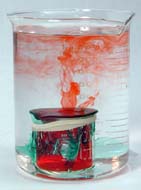
1. Fill the small cup or beaker with very hot (almost boiling) water and add several drops of food coloring. Stretch the plastic wrap smoothly over the cup and seal it with the rubber band. (The plastic wrap will puff up—this is because the hot air above the water is expanding!)
2. Fill the jar almost full with cold water from the tap.
3. Use a pair of tongs to set the cup of hot water in the bottom of the jar.
4. Slice open the plastic wrap with the knife and watch what happens! (One long gash should do it.)
What happened? The hot water was less dense than the cold water surrounding it, so it rose to the top in a convection current. What happens as the colored water gets to the top? Does it stay there? Why or why not?
Experiment 2: Sea Breeze
Air seems like the lightest thing in the world, but it actually pushes down on you and the ground with a great deal of force. This force is called air pressure. Air pressure doesn’t always stay the same; meteorologists measure its changes with a barometer. In the last experiment we saw that when air heats up it begins to rise. When it rises, it doesn’t push on the ground with as much pressure. An area full of light, warm air is called a low-pressure zone. Areas with cool, denser air are called high-pressure zones. What happens when a low-pressure zone and a high-pressure zone are right next to each other? Do this experiment to find out! Have an adult help you with the oven and matches.
What You Need:
What You Do:
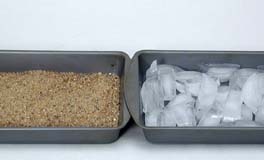
1. Set up the experiment in an area where it will be protected from drafts. If you need to, you can make a three-sided screen by cutting off one side of a cardboard box.
2. Pour some sand into one of the pans and put it in the oven to heat it up. (300 degrees for 5-8 minutes.)
3. While the sand is heating up, light a candle and then blow it out. Which direction does the smoke flow? If you have protected your area from drafts, it should flow straight up just like your convection current.
4. Fill the second pan full of ice. Put the pan of hot sand and the pan of ice side by side. (Set the hot pan on a pot holder!)
5. Light the candle again and blow it out, then hold it in between the two pans, right above the edge of the ice pan. Which direction does the smoke flow?
What happened? When you lit the candle the first time you did it in an area where the air pressure was constant, so the smoke flowed straight up. When you set the pans side by side, the ice cooled the air around it, creating a mini high-pressure zone, and the sand warmed the air around it to create a mini low-pressure zone. Air always flows from a high-pressure zone to a low-pressure zone to even up the pressure – this is what causes wind. You made a tiny breeze between the pan of ice and the pan of sand, and the smoke floated sideways in the breeze. The same thing happens between cold ocean water and hot beach sand, which is why there is almost always a breeze at the beach!
Air pressure changes cause wind, but they are responsible for other types of weather too. A low-pressure zone usually causes clouds and rain, because as the hot air rises it carries with it evaporated moisture that can condense into clouds. A high-pressure zone usually results in clear skies and sunny days because sinking currents prevent moisture from rising up and forming clouds.
Try tracking the air pressure for a few days in your area and see how it relates to the weather. You can use a barometer, or check the National Weather Service website.
Experiment 3: Evaporation Station
Low-pressure zones create clouds because the rising hot air carries moisture with it. The moisture is in the form of a gas called water vapor. When the water vapor cools, it forms water droplets that join together to form clouds. How does the water vapor get into the air in the first place? Most of it comes from evaporation. Evaporation happens when water molecules warm up – they gain enough energy to change from a liquid into a gas, and then they rise up into the air to be carried on rising convection currents.. You have seen this happen in your kitchen when steam rises from boiling water.
Are there factors that can change how fast water evaporates? You can find out by setting up an experiment to test the effect of wind, temperature and surface area on the rate of evaporation. The following procedure will give you the basics, but feel free to come up with your own methods of testing and measuring the results. This kind of experiment would make a great science fair project. (Be patient: some of these tests can take more than one day!)
What You Need:
- two kitchen sponges (they should be the same size)
- electric fan
- lamp
- small glass or beaker
- pie pan or shallow dish
Question & Hypothesis: How do factors such as wind, temperature, and surface area affect the rate of evaporation? Will wind or heat cause water to evaporate faster? Will a greater surface area speed up or slow down evaporation? Write down your predictions.
What You Do:
1. Test the effect of temperature using an incandescent lamp to provide heat. Place two kitchen sponges on plates and pour 1/8 cup (C) water over each of them. (Depending on the size of the sponge, you may need to use a bit more water. Use enough to get the sponge wet all the way through.) Place one of the sponges directly under a lamp and the other at room temperature out of direct sunlight. Observe the sponges at regular intervals, and reduce the time between observation as they get nearer to drying. Record how long it took for each sponge to dry completely. Which sponge dried faster?
2. Test the effect of wind using an electric fan. Wet the sponges as you did in step 1. Set one sponge 12 inches away from an electric fan and turn the fan on. Set the other sponge some place out of the draft. Observe the sponges at regular intervals. Record how long it took for each sponge to dry completely. Which one dried faster? Did the sponge in the fan dry faster than the one under the lamp in step 1?
3. Finally, test the effect of more or less surface area. Pour 1/8 C water into a small glass. Find the surface area of the water in the cup using the equation π r 2 (π = 3.14, r = radius. Find this by measuring the diameter of the cup and dividing this by two). Pour 1/8 C of water into a pie pan or wide shallow dish. Measure the surface area of the water in this container. Set the cup and the pan on the counter and check them a few times a day. Which water evaporates faster – the water with the small surface area or the large surface area?
Conclusions: Were your predictions correct? Which speeds up evaporation more, wind or heat? Based on your results, do you think the temperature or speed of wind would affect the evaporation rate? Can you think of other factors to test or a more precise way to test these factors again?